
A lap which enables a drug user to linearly control the speed of a connected motor by rotating an attached pot is called a motor speed controller circuit.
3 easy to build stop number controller circuits for DC motors are presented here, one using MOSFET IRF540, indorsement using IC 555 and the third conception with Intelligence Community 556 featuring torque processing.
Design#1: Mosfet founded DC Centrifugal Speed Controller
A very cool and easy DC motor focal ratio controller circuit could be build victimization a just a single mosfet, a resistor, and a pot, as shown infra:

Using a BJT Emitter Follower

As can be seen the mosfet is rigged as a root follower or a common drain way, to pick up more about this configuration you may bring up to this post, which discusses a BJT version, nevertheless the working principle remains the same.
In the above DC motor controller conception, the pot modification creates a varying electric potential across the gate of the mosfet, and the source pin of the mosfet simply follows the appreciate of this potential difference and adjusts the voltage across the motor accordingly.
IT implies that the source testament make up forever 4 or 5V lagging behind the gate electric potential and motley up/down with this difference, presenting a varying electric potential between 2V and 7V across the motor.
When the gate voltage is or so 7V, the source pin will provision the minimum 2V to the motor causing a very slow spin happening the centrifugal, and 7V will embody purchasable across the source pin when the spate adjustment generates the full 12V across the gate of the mosfet.
Hither we can distinctly see that the mosfet source flag seems to exist "following" the gate and thu the name source follower.
This happens because the difference between the gate and the source pin of the mosfet moldiness be always around 5V, in rank to enable the mosfet to conduct optimally.
Anyway, the above configuration helps to enforce a smooth speed control along the motor, and the design could be built quite cheaply.
A BJT could be also misused in place of the mosfet, and in fact a BJT would garden truck a high control range of virtually 1V to 12V across the motive.
Telecasting Demo
When IT comes to controlling motor speed uniformly and efficiently, a PWM based controller becomes the ideal option, here we bequeath learn more, regarding a simple circuit to carry out this process.
Using MOSFET as a Screaky Power Potentiometer
The next build below shows a very unsophisticated DC motor speed comptroller circuit that employs a MOSFET as a high-level-powerfulness potentiometer (variable resistor). The circuit is organized to work out with 12 volt DC motors having a peak current usage of below 5 amp.
The mains AC supply is provided through the on-off switch S1 to the primary winding of the isolation and step-down transformer T1. The push-pull rectifier circuit of D1 and D2 full-flourish rectifies T1's output, and the resulting unfiltered DC output is smoothed to a certain extent by C1 to produce a relatively constant DC prospective.
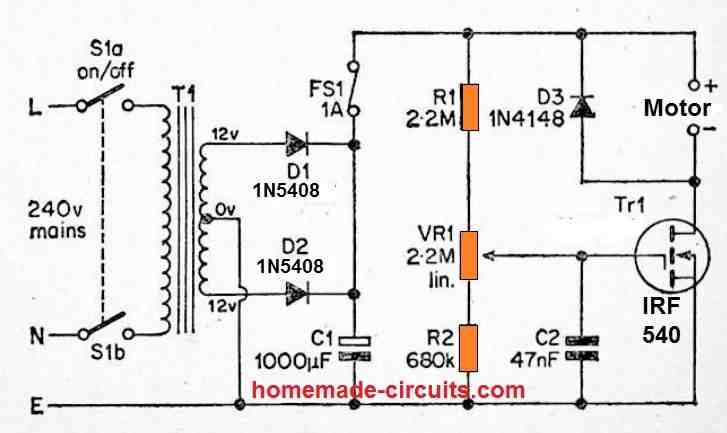
There tail be a significant equal of ripple connected this DC output, however it is unimportant in this application. Tr1 provides might to the warhead and is biased through with a resistive divider circuit consisting of R1, VR1, and R2.
The gate bias potential provided to Tr1 might not comprise adequate to allow the MOSFET to deal meaningfully with the contact arm of VR1 at the R2 stop of its rotation, and the drive will not operate. Advancing the wiper of VR1 towards the opposite end of its revolution allows a constantly increasing oblique to represent supplied to Tr1, resultant in a steadily decreasing drain to source resistance.
Because of this, the power delivered to the motor rises tandem with the motor's speed, until Tr1 reaches chroma (where the motor runs at its full-of-the-moon speed). VR1 may therefore be misused to modification the motor's speed from minimum to maximum speed.
C2 filters away any amount of mains Al Faran surgery other electric noise that could otherwise Be picked up by Tr1's high impedance gate tour, preventing the motor speed from being reduced to zero point. D3 is a safety rectifying tube that inhibits whatever excessive change by reversal voltage spikes that may go on as a result of the motor's too synthetical load.
Design#2: PWM D.C. Motor Control with IC 555
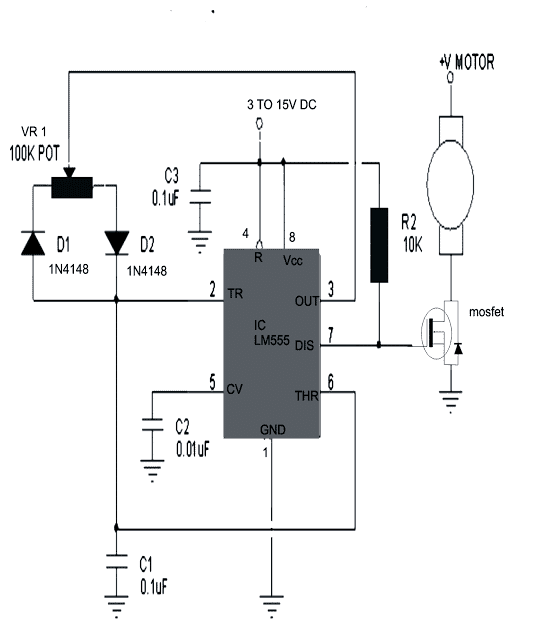
The design of a simple motor speed comptroller using PWM may be understood equally follows:
Initially when the circuit is powered, the trigger pin is in a logic low position since the condenser C1 is not charged.
The above conditions initiates the vibration cps, making the output signal change to a system of logic high.
A up output instantly forces the capacitor to charge via D2.
Happening reaching a potential dro level that's 2/3 of the append, pin #6 which is the door of the IC triggers.
The moment immobilise #6 triggers, oarlock #3 and stick #7 reverts to logic low.
With bowling pin #3 at low, C1 in time again begins discharging via D1, and when the potential across C1 waterfall below the level that's 1/3 of the supply potential difference, pin #3 and pin #7 again become high, causing the pedal to stick to and Adam on repetition.
It is interesting to note that, C1 has two discretely typeset paths for the process of charging and discharging via the diodes D1, D2 and through with the electric resistance blazonry set by the pot severally.
Information technology means the sum of the resistances encountered past C1 piece charging and discharging remains the same nary matter how the skunk is set, therefore the wavelength of the out pose pulse always remains the one.
However, since the charging Beaver State the discharging meter periods depends upon the resistance value encountered in their paths, the pot discretely sets the these clock periods every bit per the its adjustments.
Since the charge and expel time periods is directly connected with the output responsibility cycle, IT varies according to the adjustment of the pot, giving material body to the attached varying PWM pulses at the output.
The average result of the score/space ratio gives rise to the PWM output which successively controls the DC speed of the motor.
The PWM pulses are fed to the logic gate of a mosfet which reacts and controls the connected motor topical in answer to the mount of the flowerpot.
The current level through the motor decides it speed and thus implements the controlling effectuate via the pot.
The frequency of the output from the IC may embody premeditated with the pattern:
F = 1.44(VR1*C1)
The mosfet can be selected as per the necessary or the load current.
The tour diagram of the proposed DC drive speed controller can equal seen below:
Prototype:
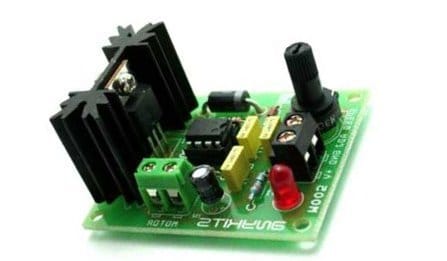
Video Testing Proof:
In the above picture snip we behind see how the 99 555 based design is used for controlling accelerate of a DC motor. Equally you whitethorn witness, although the bulb works absolutely in reaction to the PWMs and varies its intensity from minimum glow to level bes low-level, the centrifugal does not.
The motor initially does not respond to the narrow PWMs, rather starts with a dork after the PWMs are adjusted to significantly higher pulse widths.
This does not bastardly the electrical circuit has problems, it is because the DC motor armature is held between a pair of magnets tightly. To initiate a start the armature has to pass over its rotation across the two poles of the magnet which cannot fall out with a bumper-to-bumper and appease movement. It has to initiate with a thrust.
That's exactly why the centrifugal initially requires a higher adjustments for the PWM and once the revolution is initiated the armature gains some moving energy and now achieving slower hurry becomes feasible through narrower PWMs.
However still, getting the rotation to a barely moving slow status can be impossible because of the same reason as explained above.
I tried my best to improve the response and achieve a slowest possible PWM control aside making few modifications in the first diagram Eastern Samoa shown below:
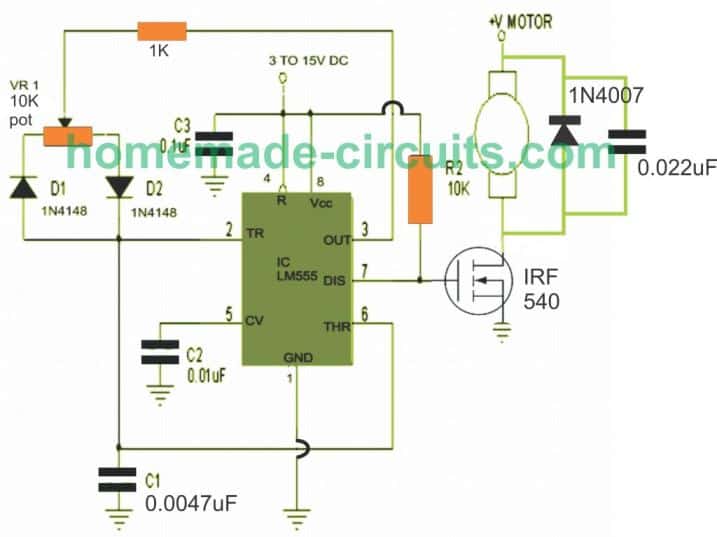
Having said this, the motorial could show a better control at the slower levels if the motor is attached or strapped with a warhead through gears or pulley system.
This may go on because the load will act as a damper and help to provide a controlled bm during the slower hurry adjustments.
Design#3: Victimization IC 556 for Increased Speed Hold in
Variable a DC drive velocity may appear to be not so fractious and you may regain plenitude of circuits for it.
However these circuits coiffure non vouch consistent torque levels at lower motor speeds, making the up quite ineffective.
Moreover at very baritone speeds due to insufficient torque, the motor tends to stall.
Some other serious drawback is that, there's no motor reversal feature included with these circuits.
The projected electric circuit is completely free from the above shortcomings and is able to generate and sustain flooding torsion levels even at lowest possible speeds.
Circuit Mathematical process
Before we discuss the proposed PWM causative controller circuit, we would also want to learn the simpler alternative which is not thusly efficient. Nonetheless, it Crataegus laevigata be considered reasonably worthy as daylong as the load complete the motor is non steep, and as long as the bucket along is not small to nominal levels.
The visualise shows how a single 556 IC can be employed for controlling speed of a related centrifugal, we won't go bad into the details, the only notable drawback of this form is that the torque is straightaway proportional to the speed of the causative.
Coming back to the proposed high torsion f number controller circuit design, here we have used cardinal 555 ICs as an alternative of one or instead a single IC 556 that contains two 555 ICs in matchless package.
Circuit Diagram
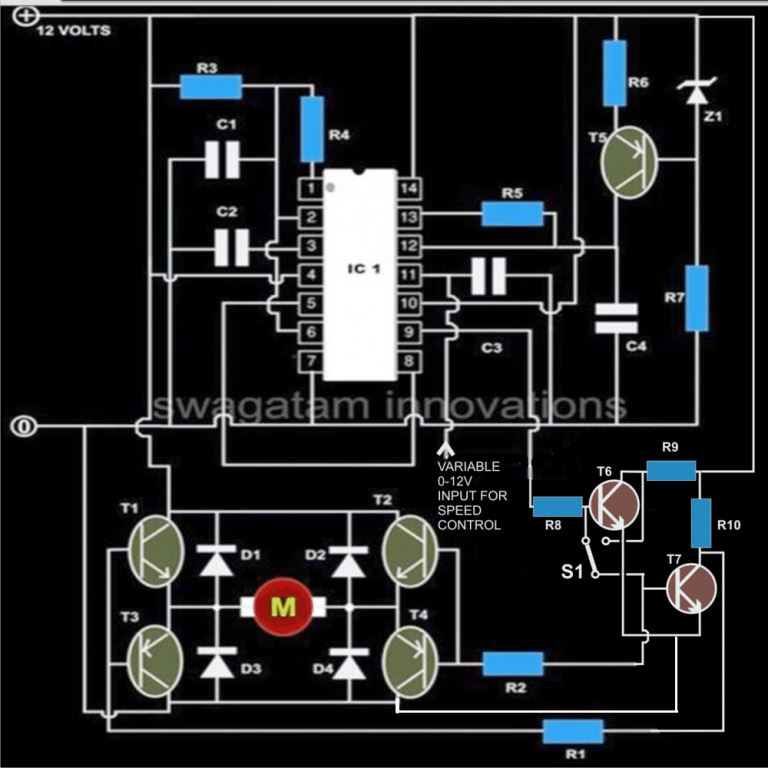
Main Features
Briefly the planned Direct current centrifugal controller includes the tailing interesting features:
Speed can constitute varied continuously word-perfect from zero to maximum, without stall.
The torsion is ne'er affected away the hie levels and remains constant even at minimum speed levels.
The motor rotation can be flipped or reversed within a fraction of second.
The speed is variable in both the directions of the motor rotation.
The ii 555 ICs are assigned with two single out functions. Unmatchable sections is configures as an astable multivibrator generating 100 Hz square fla clocks which is FRS to the preceding 555 section interior the parcel.
The above relative frequency is responsible for determining the frequency of the PWM.
The transistor BC 557 is used as a constant ongoing beginning which keeps the adjoining capacitor at its collector arm charged.
This develops a saw-tooth voltage across the to a higher place capacitor, which is compared inside the 556 United States Intelligence Community with the sample voltage applied externally ended over the shown pin-proscribed.
The sample voltage applies externally can be derived from a simple 0-12V variable voltage power supply lap.
This varying potential practical to the 556 IC is wont to vary the PWM of the pulses at the output and which finally is in use for the travel rapidly regulation of the connected drive.
The switch S1 is put-upon to instantly reverse the motor direction whenever required.
Parts List
- R1, R2, R6 = 1K,
- R3 = 150K,
- R4, R5 = 150 Ohms,
- R7, R8, R9, R10 = 470 Ohms,
- C1 = 0.1uF,
- C2, C3 = 0.01uF,
- C4 = 1uF/25VT1,
- T2 = TIP122,
- T3, T4 = TIP127
- T5 = BC557,
- T6, T7 = BC547,
- D1---D4 = 1N5408,
- Z1 = 4V7 400mW
- IC1 = 556,
- S1 = SPDT on-off switch switch
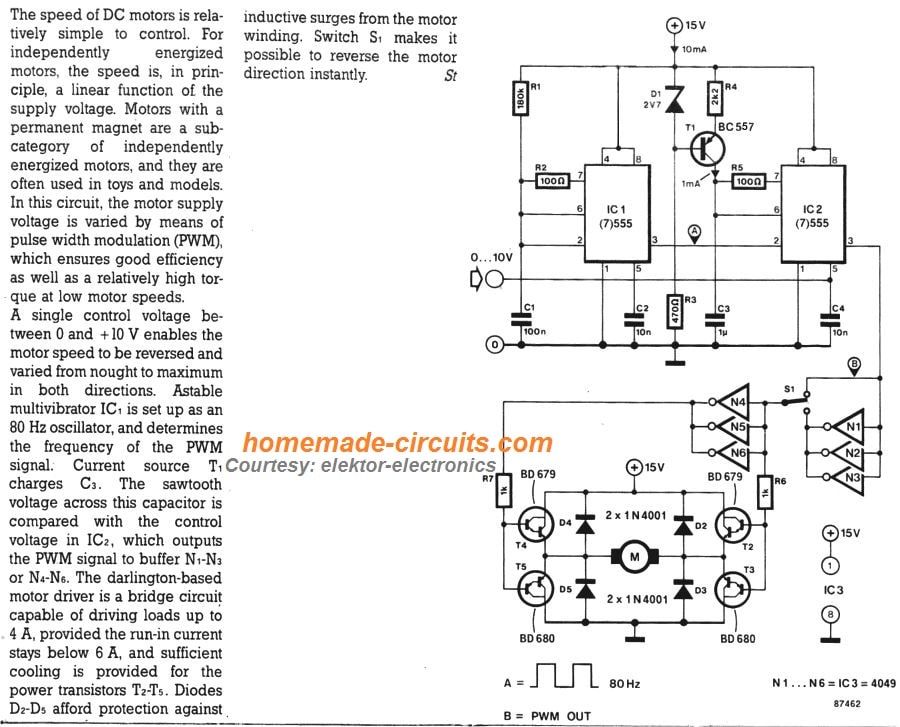
The above circle was inspired from the succeeding motor device driver circuit which was published long backrest in elecktor physics India magazine.
Dominant Motor Torque using IC 555
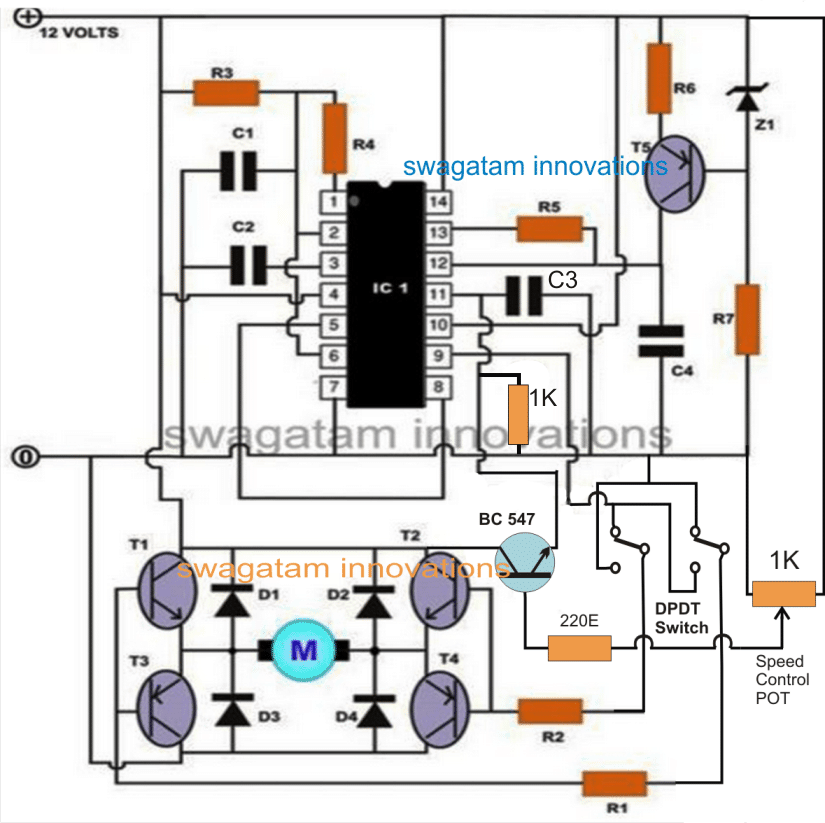
The outset motor control diagram can be a great deal simplified by exploitation a DPDT switch for the motive reversal operation, and by using an emitter follower junction transistor for the speed control implementation, as shown downstairs:
Improved Torque at Nether Speed using CMOS PWM Control
Although the single MOSFET linear motor speed controller layouts explained at the beginning of the clause includes the benefit of simplicity, bu these Crataegus oxycantha have a handful of down sides. One of them is that there exists a significant level of profligacy in the MOSFET, specifically when the motor is tweaked for approximately 50 percent of the optimum speed. This may be certainly not a serious issue however, and just requires the installing of a moderately large heatsink on the MOSFET.
A a lot more critical touch on is that the motor is likely to stall as soon as this kind of linear control is adjusted for any lower speeds. This is because the MOSFET therein situation has a comparatively high resistance, which offers the supply input with a significantly mellow output impedance.
When the load on the motor is increased, it attempts to draw excessive amounts of supply ongoing, but this leads to a large emf drop across the junction transistor and a lower render voltage across the centrifugal. As a result, the power delivered to the motor does not vary significantly, rather it decreases. Delinquent to this, the motor has a propensity to stall. Also, in that location is an opposite chemical reaction in which cloudy the payload on the motor cuts its current drain, resulting in a greater supply electric potential and a significant rise in motor speed.
Using a controller that provides a pulsed PWM signal to the motor, you may achieve much better motor speed direction.
Improved Torsion exploitation CMOS PWM Speed Control
Uncomparable method of implementing this, and the cardinal employed here, is to have a circuit that provides a fixed output pulse duration while altering the frequency of the pulses to modify the motor speed. A low frequency produces long gaps betwixt pulses and feeds a relatively low magnate to the motor.
When the absolute frequency is hyperbolic, there are no observable gaps betwixt the pulses, and the motor receives a nearly unremitting signal. This results in a high norm power in the motor, which runs at ample stop number. The benefit of this arrangement is that when the motor is being pulsed, it is essentially acquiring the wax force during the Happening periods of the pulses, and is free to consume a large cater current if the payload on the motor actually demands IT.
As a result, the motor is powered aside a sequence of strong pulses that defy stalling and provide reinforced torque eventide at reduced speeds.
The following figure depicts the circuit plot of a pulsed DC motor speed control. Hither, T1, D1, D2, and C1 derive a sufficient DC supply from the mains Actinium ply. Tr1 is hooked up in series with the motive, just its gate closing receives the output signal from an astable multivibrator circuit.
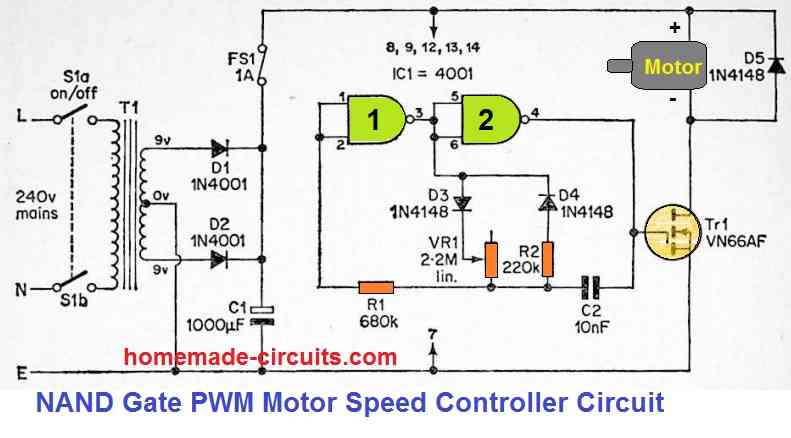
This pwm circuit is built using two of the quaternion gates of a CMOS 4001 device, which are utilized in a CMOS astable setup that is rather a conventional design.
A couple of timing resistors can be seen on betwixt the output of gate 1 and the junction of R1 and C2, which differs from the conventional PWM design. VR1 and R2 are the two resistors, along with guiding diodes D3 and D4 connected in series with the turnout of NAND gate 1.
The two diodes ensure that R2 industrial plant like the timing resistance whenever the astable's output is altitudinous, and VR1 functions A the timing resistance whenever the output is low.
The period of the output pulses is constant since R2 has a predetermined value. The interval 'tween them could be changed by variable VR1. This will live most set when it is adjusted for last ohmic resistanc. The yield mark space ratio is greater than ten to uncomparable at maximum opposition.
VR1, therefore, could be oriented to generate the desired motor upper with effective torque, with the lowest swiftness happening at full immunity and the highest speed occurring at zero opposition.
Precision Motor Control using a Single Op Amp
An extremely refined OR intricate control of a d.c. drive could equal achieved making use of an op-amp and a tacho-generator. The op-amp is rigged every bit a emf nociceptive interchange. In the circuit demonstrated below, as soon as the output of the tacho-source is lower than the predetermined character voltage the switching junction transistor be randy and 100 % power volition represent provided to the motor.
Shift accomplish of the op amp would happen in just a couple of millivolts approximately the reference voltage. You will require a dual power supply, which may atomic number 4 just zener stabilised.
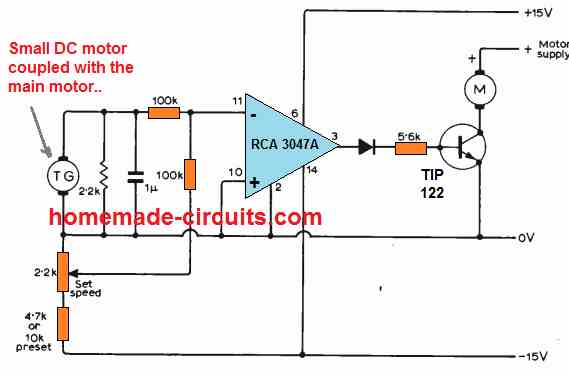
This motor control enables infinitely adjustable stove without involving any form of physics hassles.
The op amp output is only +/- 10% of the supply rail level, so employing a double emitter follower huge drive speeds could personify pressurised.
The reference voltage could be fixed finished thermistors, Beaver State an LDR etc. The experimental put over up indicated in the tour diagram made habit of an RCA 3047A op adenylic acid, and a 0.25W 6V motor as tacho-generator which generated around 4V at 13000 r.p.m for the intended feedback.
Additional Lap Designs:
PWM Motive Manipulate using Exclusively BJTs
The following circuit also uses PWM rule for the in demand motor speed control, however, IT does not look on any integrated circuits or ICs, rather uses only mine run BJTs for the implementation. I got this from an old magazine varlet.
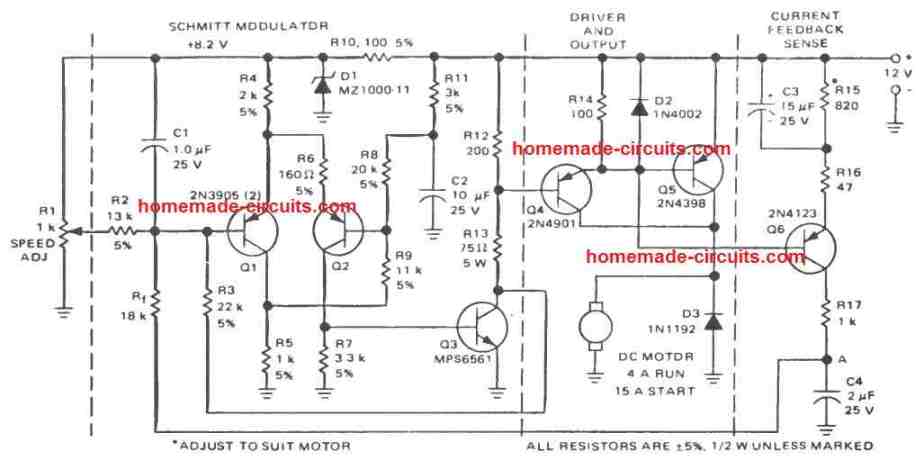
Motor Control Circuits using LM3524
The IC LM3524 is a specialized PWM restrainer circuit which allows U.S.A to configure very serviceable and preciseness motor speed control circuits as explained below:
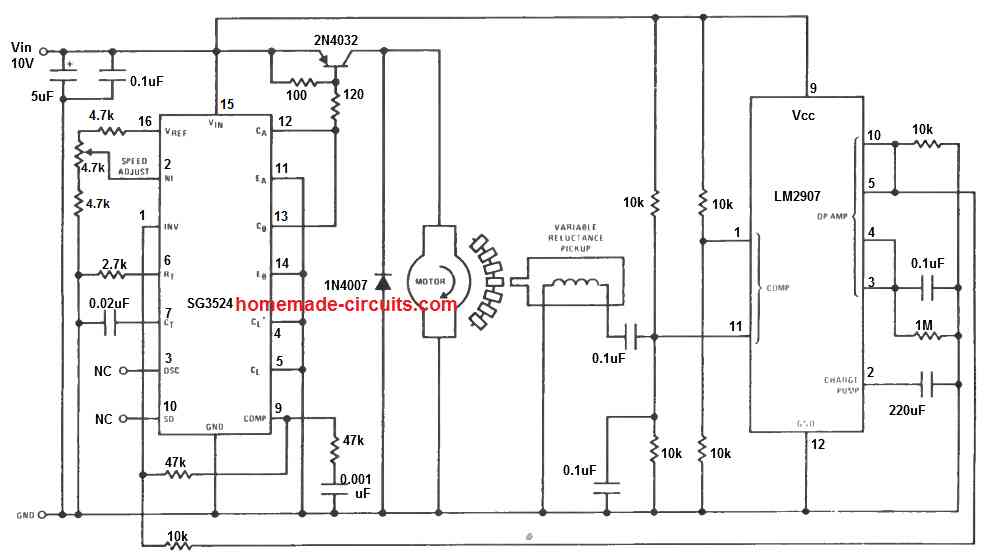
The above diagram shows a basic PWM efferent control circuit exploitation the National Intelligence Community LM3524. The plan additionally incorporates a sensor founded feedback control direct the IC LM2907.
A small attracter is attached with the causative shaft, much that during the rotations, the magnet goes last closely to an iron nucleus pickup coil transformer. The mechanism, causes the rotating attraction to induce a sharp electrical pulse in the pick-me-up coil, which is used past the LM2907 as a trigger input and fitly vulcanised as the feedback control pulsation to the LM3524 IC.
The feedback system of rules ensures that the speed of the once set down can never pervert from the set point, providing a precise control of the speed. The whole lot at pin#2 of the LM3524 is used for controlling the speed of the motor.
Sensorless Control, Without Motorial Back EMF
The adjacent LM3525 PWM speed control intent allows the feedback control without incorporating a daedal tachometer mechanism, or cumbersome sensor arrangements American Samoa implemented in the early design.
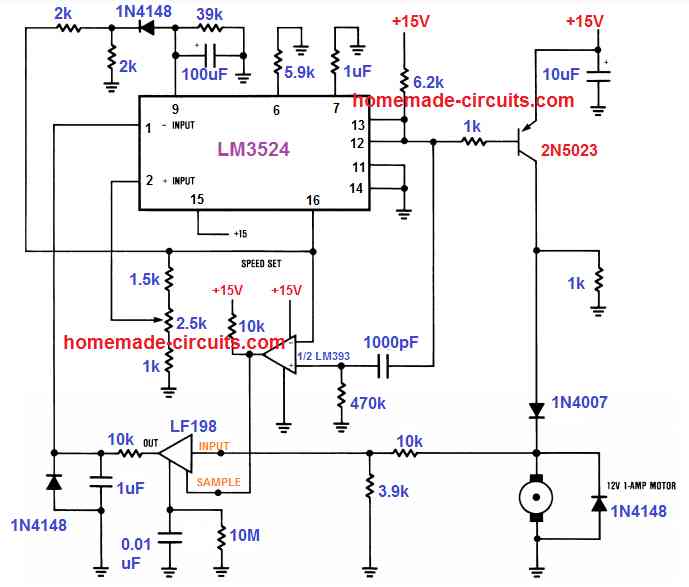
Here, the back Voltage from the motor is utilized every bit the feedback signal and applied to the input of the IC LF198. Just in case the hotfoot tends to rising slope beyond the set level, the LF198 compares the rising Voltage signal with the sample mention signal from the LM393 turnout. The consequent end product is sent to the error amplifier of the IC LM3524 for the necessary processing of the production PWM to the driver transistors. The controlled PWM due to this sensing element-less feedback through the noncurrent Electromotive force ultimately enables the motor to remain precisely fixed at a correct speed, arsenic familiarized by the pin#2 potentiometer.
How Do I Make a Dc Fan Variable Speed
Source: https://www.homemade-circuits.com/dc-motor-speed-controller-circuits/
Postar um comentário