 | |
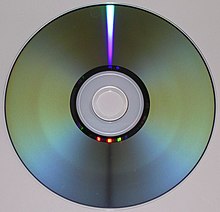 The data side of a DVD manufactured by Sony DADC | |
| Media blazon | Optical disc |
|---|---|
| Encoding | DVD-ROM and DVD-R(W) use one encoding, DVD-RAM and DVD+R(West) uses another |
| Capacity | iv.vii GB (single-sided, single-layer – common) 8.5 GB (single-sided, double-layer) 9.4 GB (double-sided, single-layer) 17.08 GB (double-sided, double-layer) Up to iv layers are possible in a standard form DVD. |
| Readmachinery | 300–650 nm light amplification by stimulated emission of radiation, x.v Mbit/southward (i×) |
| Writemechanism | 650 nm laser with a focused beam using more power than for reading, 10.5 Mbit/south (ane×) |
| Standard | DVD Forum'southward DVD Books[1] [two] [iii] and DVD+RW Alliance specifications |
| Developedby | Sony Panasonic Philips Toshiba |
| Dimensions | Bore: 12 cm (4.vii in) Thickness: ane.2 mm (0.047 in) |
| Weight | 16 grams (0.56 oz) |
| Usage | Home video (replaced past Hard disk-DVD and Blu-ray), Calculator data storage |
| Extendedfrom | LaserDisc Compact disc |
| Extendedto |
|
| Released | November 1, 1996 (1996-11-01) (Japan)[4] January 1997 (1997-01) (CIS and other Asia) March 24, 1997 (1997-03-24) (United states of america)[five] [6] [vii] March 1998 (1998-03) (Europe) February 1999 (1999-02) (Commonwealth of australia/New Zealand) |
The DVD (mutual abridgement for Digital Video Disc or Digital Versatile Disc)[8] [ix] is a digital optical disc data storage format invented and developed in 1995 and released in late 1996. Currently allowing up to 17.08 GB of storage[10], the medium tin shop any kind of digital data and was widely used for software and other figurer files as well as video programs watched using DVD players. DVDs offer higher storage capacity than compact discs while having the aforementioned dimensions.
Prerecorded DVDs are mass-produced using molding machines that physically postage stamp data onto the DVD. Such discs are a course of DVD-ROM because data can only be read and not written or erased. Bare recordable DVD discs (DVD-R and DVD+R) can be recorded once using a DVD recorder and and then part every bit a DVD-ROM. Rewritable DVDs (DVD-RW, DVD+RW, and DVD-RAM) tin exist recorded and erased many times[eleven].
DVDs are used in DVD-Video consumer digital video format and in DVD-Sound consumer digital sound format besides equally for authoring DVD discs written in a special AVCHD format to hold high definition material (often in conjunction with AVCHD format camcorders). DVDs containing other types of information may be referred to as DVD data discs.
Etymology [edit]
The Oxford English Dictionary comments that, "In 1995, rival manufacturers of the product initially named digital video disc agreed that, in order to emphasize the flexibility of the format for multimedia applications, the preferred abbreviation DVD would be understood to denote digital versatile disc." The OED also states that in 1995, "The companies said the official proper noun of the format will simply be DVD. Toshiba had been using the proper name 'digital video disc', but that was switched to 'digital versatile disc' after computer companies complained that it left out their applications."[12]
"Digital versatile disc" is the explanation provided in a DVD Forum Primer from 2000[13] and in the DVD Forum's mission statement.[xiv]
History [edit]
Development [edit]
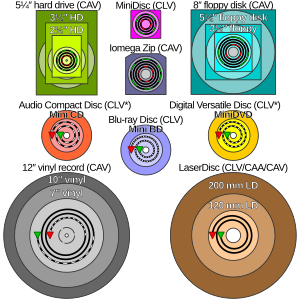
Comparing of several forms of disk storage showing tracks (tracks not to scale); dark-green denotes offset and red denotes finish.
* Some CD-R(W) and DVD-R(W)/DVD+R(Due west) recorders operate in ZCLV, CAA or CAV modes, merely most work in constant linear velocity (CLV) mode.

There were several formats adult for recording video on optical discs earlier the DVD. Optical recording technology was invented by David Paul Gregg and James Russell in 1963 and first patented in 1968. A consumer optical disc data format known as the LaserDisc was developed in the United states, and showtime came to marketplace in Atlanta, Georgia in December 1978. It used much larger discs than the later formats. Due to the loftier cost of players and discs, consumer adoption of the LaserDisc was very low in both Due north America and Europe, and was non widely used anywhere outside Japan and the more affluent areas of Southeast Asia, such as Hong Kong, Singapore, Malaysia and Taiwan.
Released in 1987, CD Video used analog video encoding on optical discs matching the established standard 120 mm (4.seven in) size of audio CDs. Video CD (VCD) became one of the first formats for distributing digitally encoded films in this format, in 1993.[15] In the same year, 2 new optical disc storage formats were being adult. I was the Multimedia Meaty Disc (MMCD), backed by Philips and Sony (developers of the CD and CD-i), and the other was the Super Density (SD) disc, supported by Toshiba, Time Warner, Matsushita Electric, Hitachi, Mitsubishi Electric, Pioneer, Thomson, and JVC. Past the fourth dimension of the press launches for both formats in January 1995, the MMCD nomenclature had been dropped, and Philips and Sony were referring to their format as Digital Video Disc (DVD).[sixteen] [17] The Super Density logo would later be reused in Secure Digital.
Representatives from the SD campsite asked IBM for advice on the file system to use for their disc, and sought back up for their format for storing estimator data. Alan East. Bell, a researcher from IBM's Almaden Inquiry Middle, got that request, and as well learned of the MMCD evolution project. Wary of existence defenseless in a repeat of the costly videotape format war betwixt VHS and Betamax in the 1980s, he convened a grouping of computer industry experts, including representatives from Apple, Microsoft, Sun Microsystems, Dell, and many others. This group was referred to equally the Technical Working Grouping, or TWG.
On May iii, 1995, an ad hoc group formed from five reckoner companies (IBM, Apple, Compaq, Hewlett-Packard, and Microsoft) issued a press release stating that they would only accept a single format.[18] [19] The TWG voted to cold-shoulder both formats unless the two camps agreed on a single, converged standard. They recruited Lou Gerstner, president of IBM, to pressure level the executives of the warring factions. In one significant compromise, the MMCD and SD groups agreed to adopt proposal SD ix, which specified that both layers of the dual-layered disc be read from the same side—instead of proposal SD 10, which would have created a two-sided disc that users would take to turn over.[20] As a result, the DVD specification provided a storage chapters of 4.vii GB (four.38 GiB)[21] for a single-layered, single-sided disc and 8.5 GB (vii.92 GiB) for a dual-layered, single-sided disc.[twenty] The DVD specification concluded up like to Toshiba and Matsushita'south Super Density Disc, except for the dual-layer selection (MMCD was single-sided and optionally dual-layer, whereas SD was two half-thickness, single-layer discs which were pressed separately and then glued together to form a double-sided disc[17]) and EFMPlus modulation designed by Kees Schouhamer Immink.
Philips and Sony decided that it was in their best interests to end the format state of war, and on September 15, 1995[22] agreed to unify with companies backing the Super Density Disc to release a single format, with technologies from both. After other compromises between MMCD and SD, the reckoner companies through TWG won the day, and a single format was agreed upon. The TWG also collaborated with the Optical Storage Technology Association (OSTA) on the use of their implementation of the ISO-13346 file system (known as Universal Deejay Format) for employ on the new DVDs. The format'south details were finalized on December viii, 1995.[23] Presently afterward the format's finalization, talks began in mid-Dec 1995 on how to distribute the format at retail.
In November 1995, Samsung announced it would start mass-producing DVDs by September 1996.[24] The format launched on November i, 1996 in Japan, mostly only with music video releases. The first major releases from Warner Home Video arrived on December 20, 1996, with four titles being available.[a] [4] The format's release in the U.Due south. was delayed multiple times, from Baronial 1996,[25] to October 1996,[26] November 1996,[27] before finally settling on early 1997.[28] Players began to produced domestically that wintertime, with March 24, 1997 as the U.Due south. launch date of the format proper in 7 examination markets.[b] [6] [29] Yet, the launch was planned for the following day (March 25), leading to a distribution modify with retailers and studios to prevent like violations of breaking the street appointment.[30] The nationwide rollout for the format happened on August 22, 1997.[31] [ ameliorate source needed ]
In 2001, blank DVD recordable discs cost the equivalent of U.s.a.$32.55 in 2020.[32] [33]
Adoption [edit]

Movie and dwelling entertainment distributors adopted the DVD format to supercede the ubiquitous VHS tape every bit the primary consumer video distribution format.[34] They embraced DVD as it produced higher quality video and sound, provided superior data lifespan, and could be interactive.[ citation needed ] Interactivity on LaserDiscs had proven desirable to consumers, especially collectors. When LaserDisc prices dropped from approximately $100 per disc to $20 per disc at retail, this luxury characteristic became available for mass consumption. Simultaneously, the pic studios decided to change their home entertainment release model from a rental model to a for buy model,[ citation needed ] and big numbers of DVDs were sold.
At the same fourth dimension, a need for interactive blueprint talent and services was created. Movies in the past had uniquely designed title sequences. Suddenly every movie being released required information compages and interactive design components that matched the film'southward tone and were at the quality level that Hollywood demanded for its production.
DVD equally a format had two qualities at the time that were not available in any other interactive medium: plenty capacity and speed to provide high quality, full motion video and sound, and low cost delivery machinery provided by consumer products retailers. Retailers would quickly motion to sell their players for under $200, and eventually for under $50 at retail. In addition, the medium itself was pocket-sized enough and light enough to postal service using general commencement class postage. Almost overnight, this created a new concern opportunity and model for concern innovators to re-invent the home amusement distribution model. It also gave companies an inexpensive way to provide business organization and product information on total motility video through direct postal service.
Immediately post-obit the formal adoption of a unified standard for DVD, two of the four leading video game console companies (Sega and The 3DO Company) said they already had plans to pattern a gaming console with DVDs as the source medium.[35] Sony stated at the time that they had no plans to utilise DVD in their gaming systems, despite being ane of the developers of the DVD format and eventually the first company to actually release a DVD-based console.[35] Game consoles such as the PlayStation two, Xbox, and Xbox 360 utilize DVDs as their source medium for games and other software. Contemporary games for Windows were as well distributed on DVD. Early DVDs were mastered using DLT record,[36] but using DVD-R DL or +R DL eventually became mutual.[37] TV DVD combos, combining a standard definition CRT Idiot box or an Hard disk apartment panel TV with a DVD machinery nether the CRT or on the back of the apartment panel, and VCR/DVD combos were also in one case available for purchase.[38]
Specifications [edit]
The DVD specifications created and updated by the DVD Forum are published as so-called DVD Books (e.grand. DVD-ROM Book, DVD-Sound Book, DVD-Video Book, DVD-R Book, DVD-RW Book, DVD-RAM Book, DVD-AR (Audio Recording) Book, DVD-VR (Video Recording) Book, etc.).[ane] [two] [3] DVD discs are made up of two discs; usually one is bare, and the other contains data. Each disc is 0.6 mm thick, and are glued together to form a DVD disc. The gluing process must be done carefully to brand the disc as flat as possible to avert both birefringence and "disc tilt", which is when the disc is non perfectly flat, preventing it from existence read.[39] [40]
Some specifications for mechanical, concrete and optical characteristics of DVD optical discs can be downloaded equally freely bachelor standards from the ISO website.[41] There are also equivalent European Computer Manufacturers Association (Ecma) standards for some of these specifications, such every bit Ecma-267 for DVD-ROMs.[42] Besides, the DVD+RW Alliance publishes competing recordable DVD specifications such as DVD+R, DVD+R DL, DVD+RW or DVD+RW DL. These DVD formats are also ISO standards.[43] [44] [45] [46]
Some DVD specifications (due east.one thousand. for DVD-Video) are not publicly available and can be obtained only from the DVD Format/Logo Licensing Corporation (DVD FLLC) for a fee of Us$5000.[47] [48] Every subscriber must sign a not-disclosure agreement equally certain information on the DVD Books is proprietary and confidential.[47] Additionally the DVD6C patent puddle holds patents used by DVD drives and discs.
The capacity of DVDs is conventionally stated in gigabytes (GB), with the decimal definition of this term such that 1 GB = ten9 bytes.
Discs with multiple layers [edit]
Like other optical disc formats earlier it, a basic DVD disc—known as DVD-five in the DVD Books, while called Type A in the ISO standard—contains a single information layer readable from only one side. However, the DVD format also includes specifications for three types of discs with additional recorded layers, expanding disc data capacity across the 4.7 GB of DVD-5 while maintaining the same physical disc size.
Double-sided discs [edit]
Borrowing from the LaserDisc format, the DVD standard includes DVD-ten discs (Type B in ISO) with two recorded data layers such that simply one layer is accessible from either side of the disc. This doubles the total nominal chapters of a DVD-10 disc to 9.four GB (viii.75 GiB), just each side is locked to 4.vii GB. Similar DVD-5 discs, DVD-10 discs are divers as unmarried-layer (SL) discs.[41]
Double-sided discs identify the sides as A and B. The disc construction lacks the dummy layer where identifying labels are printed on unmarried-sided discs, and then data such as title and side are printed on one or both sides of the non-information clamping zone at the middle of the disc.
DVD-10 discs savage out of favor because, unlike dual-layer discs, they require users to manually flip them to admission the complete content (a relatively egregious scenario for DVD movies) while offering but a negligible do good in capacity. Additionally, without a non-data side, they proved harder to handle and store.
Dual-layer discs [edit]
Dual-layer discs likewise employ a second recorded layer, nonetheless both are readable from the same side (and unreadable from the other). These DVD-9 discs (Blazon C in ISO) about double the capacity of DVD-five discs to a nominal eight.v GB, but autumn below the overall capacity of DVD-10 discs due to differences in the concrete data structure of the additional recorded layer. Nonetheless, the advantage of not needing to flip the disc to access the complete recorded data – permitting a nearly face-to-face feel for A/5 content whose size exceeds the capacity of a unmarried layer – proved a more than favorable pick for mass-produced DVD movies.
DVD hardware accesses the additional layer (layer 1) by refocusing the laser through an otherwise normally-placed, semitransparent first layer (layer 0). This laser refocus—and the subsequent fourth dimension needed to reacquire light amplification by stimulated emission of radiation tracking—can crusade a noticeable interruption in A/V playback on earlier DVD players, the length of which varies between hardware.[49] A printed message explaining that the layer-transition pause was non a malfunction became standard on DVD go along cases. During mastering, a studio could make the transition less obvious by timing information technology to occur just before a camera angle change or other abrupt shift, an early on example being the DVD release of Toy Story.[50] Later in the format's life, larger information buffers and faster optical pickups in DVD players made layer transitions effectively invisible regardless of mastering.
Dual-layer DVDs are recorded using Reverse Rail Path (OTP).[51] About dual-layer discs are mastered with layer 0 starting at the inside diameter and proceeding outward—as is the case for most optical media, regardless of layer count—while Layer 1 starts at the absolute outside diameter and gain in. Additionally, data tracks are spiraled such that the disc rotates the same direction to read both layers. DVD video DL discs tin can be mastered slightly differently: a single media stream can be divided between the layers such that layer i starts at the same diameter that layer 0 finishes. This modification reduces the visible layer transition pause considering after refocusing, the laser remains in identify rather than losing boosted time traversing the remaining disc bore.
DVD-9 was the outset commercially successful implementation of such technology.[ when? ] [ citation needed ]
Combinations of the above [edit]
DVD-eighteen discs (Type D in ISO) effectively combines the DVD-9 and DVD-10 disc types by containing four recorded data layers (allocated as two sets of layers 0 and one) such that only one layer fix is attainable from either side of the disc. These discs provide a full nominal capacity of 17.0 GB, with 8.v GB per side. This format was initially used for boob tube series released on DVD (like the first releases of Miami Vice and Quantum Bound), just was somewhen abandoned in favor of single sided discs for reissues.
The DVD Book also permits an boosted disc type chosen DVD-14: a hybrid double-sided disc with one dual-layer side, 1 single-layer side, and a total nominal capacity of 12.3 GB.[52] DVD-xiv has no counterpart in ISO.[41]
Both of these additional disc types are extremely rare due to their complicated and expensive manufacturing.[52]
 Note: The higher up sections regarding disc types pertain to 12 cm discs. The aforementioned disc types exist for 8 cm discs: ISO standards still regard these discs equally Types A–D, while the DVD Book assigns them distinct disc types. DVD-14 has no coordinating 8 cm type. The comparative data for viii cm discs is provided farther down.
DVD recordable and rewritable [edit]


A DVD burner drive for a PC
HP initially developed recordable DVD media from the need to store data for backup and transport.[53] [ failed verification ] DVD recordables are at present also used for consumer audio and video recording. Three formats were developed: DVD-R/RW, DVD+R/RW (plus), and DVD-RAM. DVD-R is available in ii formats, General (650 nm) and Authoring (635 nm), where Authoring discs may be recorded with CSS encrypted video content merely General discs may not.[54]
Although most electric current DVD writers tin can write in both the DVD+R/RW and DVD-R/RW formats (usually denoted by "DVD±RW" or the existence of both the DVD Forum logo and the DVD+RW Alliance logo), the "plus" and the "nuance" formats use unlike writing specifications. Most DVD hardware plays both kinds of discs, though older models tin can have trouble with the "plus" variants.
Some early DVD players would cause impairment to DVD±R/RW/DL when attempting to read them.[ citation needed ]
The course of the spiral groove that makes upwards the structure of a recordable DVD encodes unalterable identification data known as Media Identification Code (MID). The MID contains information such as the manufacturer and model, byte capacity, allowed data rates (too known as speed), etc..[ citation needed ]
Dual-layer recording [edit]
Dual-layer recording (occasionally called double-layer recording) allows DVD-R and DVD+R discs to store virtually double the data of a unmarried-layer disc—8.5 and iv.7 gigabyte capacities, respectively.[55] The boosted chapters comes at a cost: DVD±DLs have slower write speeds as compared to DVD±R.[ commendation needed ] DVD-R DL was developed for the DVD Forum by Pioneer Corporation; DVD+R DL was developed for the DVD+RW Alliance by Mitsubishi Kagaku Media (MKM) and Philips.[56]
Recordable DVD discs supporting dual-layer technology are backward-compatible with some hardware developed before the recordable medium.[56] Many current DVD recorders support dual-layer technology, and while the costs became comparable to single-layer burners over time, bare dual-layer media has remained more than expensive than single-layer media.[ citation needed ]
Capacity [edit]
The bones types of DVD (12 cm diameter, unmarried-sided or homogeneous double-sided) are referred to by a rough approximation of their chapters in gigabytes. In draft versions of the specification, DVD-5 indeed held five gigabytes, just some parameters were changed later on equally explained above, so the capacity decreased. Other formats, those with viii cm diameter and hybrid variants, acquired similar numeric names with fifty-fifty larger deviation.
The 12 cm blazon is a standard DVD, and the 8 cm variety is known as a MiniDVD. These are the same sizes every bit a standard CD and a mini-CD, respectively. The capacity by surface surface area (MiB/cmii) varies from 6.92 MiB/cm2 in the DVD-1 to 18.0 MB/cm2 in the DVD-18.[ clarification needed ]
Each DVD sector contains 2,418 bytes of data, 2,048 bytes of which are user information. There is a modest divergence in storage space between + and - (hyphen) formats:
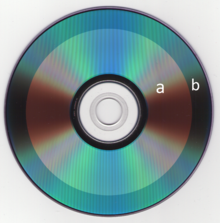
Scan of a DVD-R; the "a" portion has been recorded on while the "b" portion has not. It may be less obvious in CD-Rs and BD-Rs.
| Designation | Sides | Layers (total) | Bore (cm) | Capacity | ||
|---|---|---|---|---|---|---|
| (GB) | ||||||
| DVD-i[59] | SS SL | i | 1 | eight | ane.46 | |
| DVD-2 | SS DL | 1 | 2 | eight | 2.65 | |
| DVD-3 | DS SL | ii | 2 | eight | 2.92 | |
| DVD-four | DS DL | two | 4 | 8 | five.31 | |
| DVD-5 | SS SL | 1 | 1 | 12 | 4.70 | |
| DVD-ix | SS DL | 1 | 2 | 12 | 8.54 | |
| DVD-10 | DS SL | two | 2 | 12 | 9.forty | |
| DVD-14[52] | DS SL+DL | 2 | 3 | 12 | 13.24 | |
| DVD-18 | DS DL | 2 | 4 | 12 | 17.08 | |
All sizes are expressed in their decimal sense (i.e. ane Gigabyte = 1,000,000,000 bytes etc.).

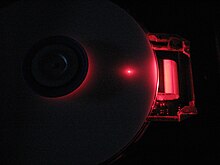
DVD-RW Bulldoze operating (performing a called-for (writing) operation) with its protective cover removed
| Designation | Sides | Layers (total) | Diameter (cm) | Chapters | ||
|---|---|---|---|---|---|---|
| (GB) | ||||||
| DVD-R | SS SL (1.0) | i | 1 | 12 | iii.95 | |
| DVD-R | SS SL (two.0) | 1 | 1 | 12 | 4.70 | |
| DVD-RW | SS SL | i | i | 12 | four.lxx | |
| DVD+R | SS SL | i | 1 | 12 | 4.seventy | |
| DVD+RW | SS SL | one | 1 | 12 | 4.seventy | |
| DVD-R | SS DL | ane | two | 12 | 8.50 | |
| DVD-RW | SS DL | i | 2 | 12 | 8.54 | |
| DVD+R | SS DL | 1 | 2 | 12 | 8.54 | |
| DVD+RW | SS DL | ane | 2 | 12 | 8.54 | |
| DVD-RAM | SS SL | 1 | 1 | 8 | ane.46* | |
| DVD-RAM | DS SL | ii | one | viii | 2.47* | |
| DVD-RAM | SS SL (1.0) | one | 1 | 12 | 2.58 | |
| DVD-RAM | SS SL (2.0) | one | one | 12 | 4.70 | |
| DVD-RAM | DS SL (1.0) | 2 | one | 12 | 5.15 | |
| DVD-RAM | DS SL (2.0) | 2 | 1 | 12 | ix.39* | |
All sizes are expressed in their decimal sense (i.e. 1 Gigabyte = ane,000,000,000 bytes etc.).
| Type | Sectors | Bytes | kB | MB | GB |
|---|---|---|---|---|---|
| DVD-R SL | 2,298,496 | iv,707,319,808 | 4,707,320 | four,707 | 4.vii |
| DVD+R SL | ii,295,104 | four,700,372,992 | iv,700,373 | four,700 | 4.vii |
| DVD-R DL | four,171,712 | 8,543,666,176 | eight,543,666 | 8,544 | 8.v |
| DVD+R DL | 4,173,824 | 8,547,991,552 | 8,547,992 | eight,548 | eight.5 |
All sizes are expressed in their decimal sense (i.eastward. 1 Gigabyte = 1,000,000,000 bytes etc.).
DVD drives and players [edit]
DVD drives are devices that tin can read DVD discs on a calculator. DVD players are a detail type of devices that practice not require a figurer to work, and can read DVD-Video and DVD-Audio discs.
Light amplification by stimulated emission of radiation and eyes [edit]
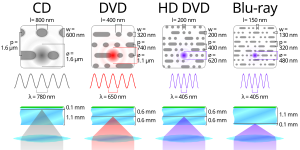
Comparison of diverse optical storage media
All three mutual optical disc media (Compact disc, DVD, and Blu-ray) use light from light amplification by stimulated emission of radiation diodes, for its spectral purity and ability to exist focused precisely. DVD uses low-cal of 650 nm wavelength (reddish), as opposed to 780 nm (far-ruddy, commonly chosen infrared) for CD. This shorter wavelength allows a smaller pit on the media surface compared to CDs (0.74 µm for DVD versus i.6 µm for CD), bookkeeping in role for DVD's increased storage capacity.
In comparing, Blu-ray Disc, the successor to the DVD format, uses a wavelength of 405 nm (violet), and one dual-layer disc has a 50 GB storage chapters.
Transfer rates [edit]
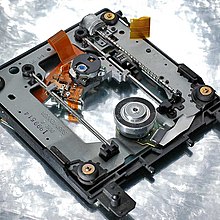
Internal mechanism of a DVD-ROM Drive. See text for details.
Read and write speeds for the first DVD drives and players were 1,385 kB/due south (1,353 KiB/s); this speed is ordinarily chosen "1×". More recent models, at eighteen× or 20×, have 18 or xx times that speed. Note that for CD drives, 1× means 153.six kB/s (150 KiB/southward), well-nigh ane-ninth every bit swift.[59] [60]
| Drive speed (non rotations) | Data rate | ~Write time (minutes)[61] | Revolutions per infinitesimal (constant linear velocity, CLV)[62] [63] [c] | ||
|---|---|---|---|---|---|
| Mbit/s | MB/s | Single-Layer | Dual-Layer | ||
| 1× | 11 | i.4 | 57 | 103 | 1400 (inner) 580 (outer)[60] |
| 2× | 22 | 2.eight | 28 | 51 | 2800 (inner) 1160 (outer) |
| 2.four× | 27 | 3.iii | 24 | 43 | 3360 (inner) 1392 (outer) |
| ii.6× | 29 | 3.vi | 22 | 40 | 3640 (inner) 1508 (outer) |
| iii× | 33 | 4.1 | 19 | 34 | 4200 (inner) 2320 (outer) |
| 4× | 44 | 5.5 | xiv | 26 | 5600 (inner) 2900 (outer) |
| 6× | 67 | 8.3 | 9 | 17 | 8400 (inner) 3480 (outer) |
| 8× | 89 | 11.1 | seven | 13 | 4640 (CAV; no longer uses pure CLV) |
| 10× | 111 | 13.9 | vi | ten | 5800 |
| 12× | 133 | sixteen.6 | five | 9 | 6960 |
| 16× | 177 | 22.two | 4 | 6 | 9280 |
| xviii× | 199 | 24.9 | 3 | vi | 10440 |
| 20× | 222 | 27.7 | 3 | 5 | 11600 |
| 22× | 244 | 30.5 | 3 | 5 | 12760 |
| 24× | 266 | 33.ii | 2 | iv | 13920 |
DVDs can spin at much higher speeds than CDs – DVDs can spin at upward to 32000 RPM vs 23000 for CDs.[64] Notwithstanding, in practice, discs should never be spun at their highest possible speed, to allow for a safety margin and for slight differences betwixt discs, and to forestall material fatigue from the physical stress.
DVD recordable and rewritable discs tin can exist read and written using either constant angular velocity (CAV), constant linear velocity (CLV), Fractional constant angular velocity (P-CAV) or Zoned Constant Linear Velocity (Z-CLV or ZCLV).[65]
Due to the slightly lower data density of dual layer DVDs (4.25 GB instead of iv.vii GB per layer), the required rotation speed is around 10% faster for the aforementioned information rate, which ways that the same athwart speed rating equals a x% college physical angular rotation speed. For that reason, the increase of reading speeds of dual layer media has stagnated at 12× (constant angular velocity) for one-half-height optical drives released since around 2005,[d] and slim type optical drives are only able to tape dual layer media at six× (abiding athwart velocity), while reading speeds of 8× are however supported past such.[70] [71] [72]
Disc quality measurements [edit]

Mistake rate measurement on a DVD+R. The error rate is still within a healthy range.
The quality and data integrity of optical media is measureable, which means that hereafter data losses caused by deteriorating media can be predicted well in advance past measuring the rate of correctable data errors.[73]
Errors on DVDs are measured as:
- PIE — Parity Inner Error
- PIF — Parity Inner Failure
- POE — Parity Outer Error
- POF — Parity Outer Failure
A college rate of errors may indicate a lower media quality, deteriorating media, scratches and dirt on the surface, and/or a malfunctioning DVD writer.
PI errors, PI failures and PO errors are correctable, while a PO failure indicates a CRC fault, one 2048 byte block (or sector) of data loss, a result of too many consecutive smaller errors.
Additional parameters that can exist measured are light amplification by stimulated emission of radiation beam focus errors, tracking errors, jitter and beta errors (inconsistencies in lengths of lands and pits).
Support of measuring the disc quality varies among optical drive vendors and models.
[74] [75]
DVD-Video [edit]
DVD-Video is a standard for distributing video/audio content on DVD media. The format went on auction in Nippon on November ane, 1996,[iv] in the U.s.a. on March 24, 1997 to line up with the 69th Academy Awards that day;[6] in Canada, Central America, and Indonesia afterward in 1997, and in Europe, Asia, Commonwealth of australia, and Africa in 1998. DVD-Video became the dominant class of home video distribution in Nippon when it first went on sale on November 1, 1996, but it shared the market place for dwelling video distribution in the United States for several years; it was June 15, 2003, when weekly DVD-Video in the Usa rentals began outnumbering weekly VHS cassette rentals.[76] DVD-Video is notwithstanding the dominant grade of dwelling house video distribution worldwide except for in Nippon where it was surpassed by Blu-ray Disc when Blu-ray first went on sale in Japan on March 31, 2006.
Security [edit]
The Content Scramble System (CSS) is a digital rights management (DRM) and encryption system employed on almost all commercially produced DVD-video discs. CSS utilizes a proprietary 40-bit stream nil algorithm. The system was introduced around 1996 and was first compromised in 1999.
The purpose of CSS is twofold:
- CSS prevents byte-for-byte copies of an MPEG (digital video) stream from existence playable since such copies do not include the keys that are hidden on the lead-in area of the restricted DVD.
- CSS provides a reason for manufacturers to make their devices compliant with an industry-controlled standard, since CSS scrambled discs cannot in principle be played on noncompliant devices; anyone wishing to build compliant devices must obtain a license, which contains the requirement that the residuum of the DRM arrangement (region codes, Macrovision, and user operation prohibition) be implemented.[77]
While about CSS-decrypting software is used to play DVD videos, other pieces of software (such as DVD Decrypter, AnyDVD, DVD43, Smartripper, and DVD Shrink) tin copy a DVD to a hard drive and remove Macrovision, CSS encryption, region codes and user performance prohibition.
Consumer restrictions [edit]
The rise of filesharing has prompted many copyright holders to display notices on DVD packaging or displayed on screen when the content is played that warn consumers of the illegality of sure uses of the DVD. Information technology is commonplace to include a ninety-second ad warning that nearly forms of copying the contents are illegal. Many DVDs prevent skipping by or fast-forwarding through this warning.
Arrangements for renting and lending differ by geography. In the U.S., the correct to re-sell, rent, or lend out bought DVDs is protected by the showtime-sale doctrine nether the Copyright Act of 1976. In Europe, rental and lending rights are more limited, under a 1992 European Directive that gives copyright holders broader powers to restrict the commercial renting and public lending of DVD copies of their work.
DVD-Audio [edit]
DVD-Audio is a format for delivering high fidelity audio content on a DVD. It offers many channel configuration options (from mono to five.i surround audio) at diverse sampling frequencies (upwardly to 24-bits/192 kHz versus CDDA'due south xvi-bits/44.1 kHz). Compared with the CD format, the much higher-capacity DVD format enables the inclusion of considerably more music (with respect to full running time and quantity of songs) or far higher audio quality (reflected by higher sampling rates, greater sample resolution and boosted channels for spatial audio reproduction).
DVD-Audio briefly formed a niche market, probably due to the very sort of format war with rival standard SACD that DVD-Video avoided.
Security [edit]
DVD-Audio discs employ a DRM machinery, called Content Protection for Prerecorded Media (CPPM), adult by the 4C group (IBM, Intel, Matsushita, and Toshiba).
Although CPPM was supposed to be much harder to crack than a DVD-Video CSS, it as well was somewhen cracked, in 2007, with the release of the dvdcpxm tool. The subsequent release of the libdvdcpxm library (based on dvdcpxm) allowed for the development of open source DVD-Audio players and ripping software. As a outcome, making 1:1 copies of DVD-Audio discs is at present possible with relative ease, much like DVD-Video discs.
Successors and reject [edit]
| | This article needs to be updated. (August 2019) |

In 2006, two new formats chosen Hard disk drive DVD and Blu-ray Disc were released as the successor to DVD. Hard disk DVD competed unsuccessfully with Blu-ray Disc in the format war of 2006–2008. A dual layer HD DVD tin store up to 30 GB and a dual layer Blu-ray disc tin can concord up to 50 GB.[78] [79]
Notwithstanding, unlike previous format changes, eastward.g., vinyl to Meaty Disc or VHS videotape to DVD, there is no immediate indication that production of the standard DVD volition gradually wind down, as they still dominate, with effectually 75% of video sales and approximately one billion DVD player sales worldwide as of April 2011. In fact, experts merits that the DVD will remain the ascendant medium for at least some other five years every bit Blu-ray engineering science is even so in its introductory stage, write and read speeds being poor and necessary hardware existence expensive and non readily available.[80] [81]
Consumers initially were besides irksome to prefer Blu-ray due to the cost.[82] By 2009, 85% of stores were selling Blu-ray Discs. A high-definition television and appropriate connectedness cables are as well required to take advantage of Blu-ray disc. Some analysts suggest that the biggest obstacle to replacing DVD is due to its installed base; a large bulk of consumers are satisfied with DVDs.[83] The DVD succeeded because it offered a compelling alternative to VHS. In addition, the uniform media size lets manufacturers make Blu-ray players (and HD DVD players) backward-uniform, and so they can play older DVDs. This stands in contrast to the alter from vinyl to CD, and from record to DVD, which involved a complete alter in physical medium. As of 2019[update] it is still commonplace for studios to issue major releases in "combo pack" format, including both a DVD and a Blu-ray disc (also as a digital copy). Also, some multi-disc sets use Blu-ray for the main feature, but DVDs for supplementary features (examples of this include the Harry Potter "Ultimate Edition" collections, the 2009 re-release of the 1967 The Prisoner Tv set series, and a 2007 collection related to Blade Runner). Another reason cited (July 2011) for the slower transition to Blu-ray from DVD is the necessity of and confusion over "firmware updates" and needing an internet connection to perform updates.
This situation is similar to the changeover from 78 rpm shellac recordings to 45 rpm and 33⅓ rpm vinyl recordings. Because the new and old media were about the same (a disc on a turntable, played by a needle), phonograph player manufacturers continued to include the power to play 78s for decades afterwards the format was discontinued.
Manufacturers continue to release standard DVD titles as of 2020[update], and the format remains the preferred ane for the release of older television programs and films. Shows that were shot and edited entirely on film, such every bit Star Trek: The Original Series, cannot exist released in high definition without being re-scanned from the original film recordings. Certain special effects were besides updated to announced better in high-definition.[84] [ unreliable source? ] Shows that were made between the early 1980s and the early 2000s were mostly shot on pic, then transferred to cassette tape, and then edited natively in either NTSC or PAL, making high-definition transfers impossible equally these SD standards were baked into the final cuts of the episodes. Star Trek: The Side by side Generation is the just such testify that has gotten a Blu-ray release. The process of making high-definition versions of TNG episodes required finding the original movie clips, re-scanning them into a computer at high definition, digitally re-editing the episodes from the ground up, and re-rendering new visual effects shots, an extraordinarily labor-intensive ordeal that cost Paramount over $12 million. The project was a financial failure and resulted in Paramount deciding very firmly against giving Deep Space Nine and Voyager the aforementioned treatment.[85] Even so, What We Left Behind included pocket-size amounts of remastered Deep Space Ix footage.
DVDs are also facing competition from video on need services.[86] [87] [88] [89] With increasing numbers of homes having loftier speed Cyberspace connections, many people now take the option to either rent or purchase video from an online service, and view it past streaming it directly from that service'due south servers, pregnant they no longer need whatsoever form of permanent storage media for video at all. By 2017, digital streaming services had overtaken the sales of DVDs and Blu-rays for the offset fourth dimension.[90]
Longevity [edit]
Longevity of a storage medium is measured by how long the information remains readable, assuming compatible devices exist that can read it: that is, how long the disc can be stored until data is lost. Numerous factors affect longevity: composition and quality of the media (recording and substrate layers), humidity and calorie-free storage weather, the quality of the initial recording (which is sometimes a matter of common compatibility of media and recorder), etc.[91] According to NIST, "[a] temperature of 64.4 °F (18 °C) and 40% RH [Relative Humidity] would be considered suitable for long-term storage. A lower temperature and RH is recommended for extended-term storage."[92]
Co-ordinate to the Optical Storage Technology Clan (OSTA), "Manufacturers merits lifespans ranging from xxx to 100 years for DVD, DVD-R and DVD+R discs and up to xxx years for DVD-RW, DVD+RW and DVD-RAM."[93]
According to a NIST/LoC research project conducted in 2005–2007 using accelerated life testing, "At that place were fifteen DVD products tested, including five DVD-R, 5 DVD+R, two DVD-RW and three DVD+RW types. At that place were ninety samples tested for each product. [...] Overall, seven of the products tested had estimated life expectancies in ambient conditions of more than 45 years. Four products had estimated life expectancies of 30–45 years in ambient storage conditions. Two products had an estimated life expectancy of 15–xxx years and two products had estimated life expectancies of less than 15 years when stored in ambient atmospheric condition." The life expectancies for 95% survival estimated in this project by type of product are tabulated below:[91] [ dubious ]
| Disc blazon | 0–xv years | xv–30 years | 30–45 years | over 45 years |
|---|---|---|---|---|
| DVD-R | 20% | 20% | 0% | threescore% |
| DVD+R | xx% | 0% | twoscore% | 40% |
| DVD-RW | 0% | 0% | 50% | fifty% |
| DVD+RW | 0% | 33.3% | 33.3% | 33.iii% |
x
20
thirty
twoscore
50
sixty
seventy
80
90
100
DVD-R
DVD+R
DVD-RW
DVD+RW
- 0–15 years
- 15–thirty years
- thirty–45 years
- over 45 years
See also [edit]
- List of computer hardware
- Book type
- Comparison of popular optical information-storage systems
- Digital video recorder
- Disk-drive performance characteristics
- DVD authoring
- DVD ripper
- DVD region code
- DVD TV game – Interactive movie
- Professional disc
- DVD single
- M-DISC
Notes [edit]
- ^ The four titles beingness The Fugitive, Bract Runner: Director's Cut, Eraser, and Assassins.
- ^ These test markets were in Chicago, Dallas, Los Angeles, New York City, San Francisco, Seattle, and Washington, D.C.
- ^ Due to the data runway circumference of 12cm discs being 2.4 times equally long at the outer edge as at the innermost border of the information area, a abiding angular velocity number equals the physical rotation speed the disc has when accessed with the aforementioned constant linear velocity number at the outermost edge. This means that the listed CLV (abiding linear velocity) speeds at the outer border equal the aforementioned number of rotations per minute as the same CAV (constant angular velocity) rating number.
- ^ The first optical drive model from a major optical drive vendor that achieved ×12 speeds on DVD-ROM Dual Layer was the Pioneer DVR-107 (2004).[66] [67] Later optical drives such as the HL data storage GSA-H10N (2006)[68] accept also achieved 12×(CAV) reading speeds on recordable dual-layer media (DVD-R DL, DVD+R DL), and TSSTcorp SH-S202/S203/TS-H653B (2007) achieved writing speeds of 12×(CAV) and 16×(CAV) on DVD-R DL and DVD+R DL respectively, on quality media from selected vendors.[69]
References [edit]
- ^ a b "DVD FLLC – DVD Format Book". Dvdfllc.co.jp. Archived from the original on Apr 25, 2010. Retrieved October 28, 2017.
- ^ a b "DVD FLLC – DVD Format Volume". Dvdfllc.co.jp. Archived from the original on February ii, 2010. Retrieved Oct 28, 2017.
- ^ a b "BOOKS OVERVIEW". Mpeg.org. Archived from the original on May 1, 2010. Retrieved Oct 28, 2017.
- ^ a b c Taylor, Jim (March 21, 1997). "DVD Frequently Asked Questions (with answers!)". Video Discovery. Archived from the original on March 29, 1997. Retrieved August 20, 2019.
- ^ Johnson, Lawrence B. (September seven, 1997). "For the DVD, Disney Magic May Be the Cardinal". The New York Times. Archived from the original on July 29, 2018. Retrieved May 25, 2009.
- ^ a b c Copeland, Jeff B. (March 23, 1997). "Oscar Day Is Also DVD Day". Eastward! Online. Archived from the original on Apr 11, 1997. Retrieved August 21, 2019.
- ^ Staff (March 24, 1997). "Artistic Does DVD". PC Gamer. Archived from the original on February 18, 1998. Retrieved December 5, 2019.
- ^ Pop Mechanics, June 1997, p. 69;
- ^ Jim Taylor, DVD demystified, McGraw Hill, 1998, 1st edition, p. 405
- ^ "CD/DVD comparing nautical chart". h71036.www7.hp.com . Retrieved Jan 26, 2022.
- ^ "Departure between DVD-R and DVD-RW". GeeksforGeeks. June 15, 2020. Retrieved January 26, 2022.
- ^ Oxford English Dictionary, DVD.
- ^ "DVD Primer". DVD Forum. September half dozen, 2000. Archived from the original on June nine, 2010. Retrieved December xiv, 2013.
- ^ "DVD Forum'southward Mission". DVD Forum. Jan 14, 2010. Archived from the original on May ten, 2014. Retrieved June 11, 2014.
- ^ "Super Video Compact Disc, A Technical Explanation (PDF)" (PDF). Philips System Standards and Licensing. 1998: 2. Archived from the original (PDF) on May 28, 2008. Retrieved February 13, 2008.
- ^ "WCES: The Calm Before the Storm". Next Generation. Imagine Media (3): 18. March 1995.
- ^ a b "DVD Plagued by Double Standards". Next Generation. Imagine Media (vi): 16–17. June 1995.
- ^ "Requirements for Time to come High-Capacity Meaty-Disc Format Announced by Figurer Industry Technical Group". Apple Computer. May iii, 1995. Archived from the original on December 2, 1998. Retrieved December 1, 2021.
- ^ "Electronic Giants Battle On". Next Generation. Imagine Media (11): nineteen. Nov 1995.
- ^ a b "DVD: coming soon to your PC?". Computer Shopper. xvi (iii): 189. March one, 1996.
- ^ 1 GB = one billion bytes
- ^ "Nokia Welcomes Single Standard for Adjacent Generation Loftier Density Optical Disc Format" (Press release). Nokia. September 26, 1995. Archived from the original on December xx, 1996. Retrieved Oct 6, 2021.
- ^ "DVD Format Unification" (Press release). Toshiba. Dec viii, 1995. Archived from the original on May 1, 1997. Retrieved October vi, 2021.
- ^ Souter, Gerry (2017) [1997]. "DVD: The 5-Inch Digital Video Disc". Buying and Selling Multimedia Services. CRC Press. ISBN978-one-136-13437-ane.
- ^ "DVD Is Go!". Japan Press Network. January 17, 1996. Archived from the original on Jan xvi, 1999. Retrieved Oct half dozen, 2021.
- ^ Elrich, David J. (July 11, 1996). "DVD Introduction Appear". E-Town News. Archived from the original on February 13, 1999. Retrieved October 6, 2021.
- ^ "Matsushita Electronics to launch DVDs in Nov". CNN. August 31, 1996. Archived from the original on January 14, 2000. Retrieved October vi, 2021.
- ^ Elrich, David J. (November 19, 1996). "Toshiba: DVD is hither -- Almost". E-Town News. Archived from the original on January sixteen, 1999. Retrieved October 6, 2021.
- ^ Gerson, Bob (March 21, 1997). "Warner's DVD Alert". E-Town News. Archived from the original on Jan 17, 1999. Retrieved October 6, 2021.
- ^ Bilzi, Jill (April 7, 1997). "DVD Street Engagement Ignored". E-Town News. Archived from the original on Jan sixteen, 1999. Retrieved October 6, 2021.
- ^ "DVD Declaration" (Press release). Warner Home Video. July 31, 1997. Archived from the original on February 19, 1999. Retrieved October half-dozen, 2021.
- ^ Applied Television, November 2001 result
- ^ Calculated pound sterling aggrandizement using https://world wide web.bankofengland.co.uk/monetary-policy/inflation/inflation-reckoner, xv pounds in 2001 to 2019 = 25 pounds, so calculated substitution rate using Google
- ^ Uhlig, Robert (Nov 22, 2004). "DVD kills the video show as digital age takes over". Telegraph.co.uk. Archived from the original on February 16, 2018. Retrieved October 28, 2017.
- ^ a b "DVD Game Consoles?". Next Generation. No. 18. Imagine Media. June 1996. p. xl.
- ^ "DVD Authoring — What is DLT?". HellmanProduction.com. Archived from the original on September 24, 2019. Retrieved April 13, 2020.
- ^ "DVD Authoring — How to make a proper DVD primary". HellmanProduction.com. Archived from the original on September 6, 2019. Retrieved April 13, 2020.
- ^ Kidman, Alex (October 21, 2010). "Toshiba 22DV615Y LCD TV/DVD Combo review". CNET. Archived from the original on July 16, 2020. Retrieved July xvi, 2020.
- ^ Watson, Stephanie (October 16, 2004). "How Blu-ray Reads Information". HowStuffWorks.com. Archived from the original on December twenty, 2019. Retrieved April 21, 2020.
- ^ Watson, Stephanie (October sixteen, 2004). "Building a Blu-ray Disc". HowStuffWorks.com. Archived from the original on Jan 15, 2020. Retrieved April 21, 2020.
- ^ a b c ISO ISO Freely Available Standards Archived October 26, 2018, at the Wayback Car, Retrieved on 2009-07-24
- ^ "Standard ECMA-267". Ecma-international.org. Archived from the original on May 22, 2013. Retrieved October 28, 2017.
- ^ ISO ISO/IEC 17344:2009, Data interchange on 120 mm and 80 mm optical disc using +R format – Chapters: 4,7 Gbytes and one,46 Gbytes per side (recording speed upwardly to 16X) Archived April 29, 2011, at the Wayback Machine, Retrieved on 2009-07-26
- ^ ISO ISO/IEC 25434:2008, Data interchange on 120 mm and 80 mm optical disc using +R DL format – Capacity: 8,55 Gbytes and 2,66 Gbytes per side (recording speed upwardly to 16X) Archived April 29, 2011, at the Wayback Machine, Retrieved on 2009-07-26
- ^ ISO ISO/IEC 17341:2009, Data interchange on 120 mm and 80 mm optical disc using +RW format – Capacity: 4,vii Gbytes and ane,46 Gbytes per side (recording speed upwards to 4X) Archived April 29, 2011, at the Wayback Machine, Retrieved on 2009-07-26
- ^ ISO ISO/IEC 26925:2009, Data interchange on 120 mm and 80 mm optical disc using +RW HS format – Chapters: 4,7 Gbytes and 1,46 Gbytes per side (recording speed 8X) Archived April 29, 2011, at the Wayback Motorcar, Retrieved on 2009-07-26
- ^ a b DVD FLLC (2009) DVD Format Book Archived Apr 4, 2010, at the Wayback Machine, Retrieved on 2009-08-xiv
- ^ DVD FLLC (2009) How To Obtain DVD Format/Logo License (2005–2009) Archived March 18, 2010, at the Wayback Machine, Retrieved on 2009-08-14
- ^ "DVD players benchmark". hometheaterhifi.com. Archived from the original on March xiii, 2008. Retrieved April 1, 2008.
- ^ DVD: The Decease Knell of Laserdisc, archived from the original on Dec 21, 2021, retrieved July 16, 2021
- ^ "DVD Studio Pro 4 User Manual". documentation.apple.com. Archived from the original on September 26, 2013. Retrieved October 28, 2017.
- ^ a b c "DVD-14". AfterDawn Ltd. Retrieved Feb half-dozen, 2007.
- ^ Watson, James. "The recordable DVD clinic". The Annals. Archived from the original on July 21, 2017. Retrieved October 15, 2001.
- ^ "DVD Media / DVD-R Media". Record Resource. Archived from the original on July 27, 2011. Retrieved August 9, 2011.
- ^ "DVDs" (PDF). PDST Engineering in Education. Archived from the original (PDF) on December 2, 2013. Retrieved January 22, 2017.
- ^ a b DeMoulin, Robert. "Agreement Dual Layer DVD Recording". BurnWorld.com. Archived from the original on April 21, 2010. Retrieved July 6, 2007.
- ^ "DVD Volume A: Physical parameters". Mpeg.org. Archived from the original on January 17, 2012. Retrieved August 22, 2009.
- ^ "AVOS Companies – OSFAL Group" (PDF). www.avos.eu. Archived from the original on May 28, 2008.
- ^ a b Taylor, Jim. "DVD Demystifed FAQ". Dvddemystified.com. Archived from the original on Baronial 22, 2009. Retrieved August 22, 2009.
- ^ a b "Agreement DVD -Recording Speed". Optical Storage Technology Association. Archived from the original on June 11, 2004. Retrieved August ix, 2011.
- ^ The write time is wildly optimistic for college (>4x) write speeds, due to being calculated from the maximum bulldoze write speed instead of the average drive write speed.[ commendation needed ]
- ^ Montilus, Clerbie (2003). Elert, Glenn (ed.). "Angular speed of a DVD". The Physics Factbook . Retrieved January 21, 2022.
- ^ "DVD-ROM". August eight, 2003. Archived from the original on August eight, 2003.
- ^ "Life in the fast lane tin be a disc-shattering experience". The Sydney Morning time Herald. December 9, 2002.
- ^ "Understanding DVD -Recording Speed". Optical Storage Applied science Association. Archived from the original on June eleven, 2004. Retrieved July 24, 2011.
- ^ "DVR-107D, DVR-107BK General Specifications" (PDF). Pioneer Electronics USA. 2004. Retrieved July 31, 2020.
- ^ Pioneer DVR-A06 brochure (2003)
- ^ "GSA-H10N, H10L, QSG-1008S (owner's manual)" (PDF). Hitachi-LG data storage. September ane, 2006. p. 3. Archived from the original (PDF) on August 17, 2020. Retrieved August 17, 2020.
- ^ "Super -writemaster DVD Author SH-S203B(TS-H653B)/ SH-S203D(TS-H653D)" (PDF) (User manual) (in Korean). Samsung Electronics. 2007. Archived (PDF) from the original on Baronial 7, 2020. Retrieved Baronial 7, 2020.
- ^ "View All Discontinued LG Burners & Drives". LG USA. Archived from the original on July 11, 2020.
- ^ "Manual".
- ^ Pioneer computer drive annal
- ^ "QPxTool – bank check the quality". qpxtool.sourceforge.io.
- ^ "QPxTool glossary". qpxtool.sourceforge.io. QPxTool. August one, 2008. Retrieved July 22, 2020.
- ^ "1 DVD "DATA" Sector – LightByte".
- ^ Bakalis, Anna (June 20, 2003). "Information technology'south unreel: DVD rentals overtake videocassettes". The Washington Times. Archived from the original on May 26, 2007.
- ^ "IEEE – Copy Protection for DVD Video p.2" (PDF). Archived from the original (PDF) on March 18, 2009.
- ^ "What is Blu-ray Disc?". Sony. Archived from the original on December three, 2009. Retrieved November 25, 2008.
- ^ "DVD FAQ: 3.13 – What about the new HD formats?". September 21, 2008. Archived from the original on August 22, 2009. Retrieved November 25, 2008.
- ^ "High-Definition Sales Far Behind Standard DVD'south Kickoff Two Years". Movieweb.com. February 20, 2008. Archived from the original on September fourteen, 2008. Retrieved August 22, 2009.
- ^ "Blu-ray takes 25% Market share". September 21, 2008. Archived from the original on June 23, 2011. Retrieved June 28, 2011.
- ^ Martorana, Robert (November four, 2009). "Ho-hum Blu-ray Adoption: A Threat to Hollywood's Bottom Line?". Seeking Alpha. Archived from the original on March 4, 2016. Retrieved Baronial nine, 2011.
- ^ "Gates And Ballmer On "Making The Transition"". BusinessWeek. April 19, 2004. Archived from the original on August 26, 2009. Retrieved August 22, 2009.
- ^ "Kirk/Spock STAR TREK To Go All-New Hd Spaceships". Aintitcool.com. Archived from the original on December ix, 2012. Retrieved August 22, 2009.
- ^ Burt, Kayti (February half-dozen, 2017). "Star Trek: DS9 & Voyager Hd Blu-Ray Will Likely Never Happen". Den of Geek. Archived from the original on October 17, 2018. Retrieved Jan 12, 2019.
- ^ "Are DVDs becoming obsolete?". Electronics.howstuffworks.com. November 1, 2014. Archived from the original on April 5, 2015. Retrieved December 30, 2016.
- ^ "Amazon.com: Customer Discussions: When will DVDs be obsolete?". Amazon.com. Archived from the original on March 5, 2016. Retrieved December 30, 2016.
- ^ Romano, Nick. "Is the DVD Becoming Obsolete?". ScreenCrush. Archived from the original on April 12, 2015. Retrieved December 30, 2016.
- ^ "DVD Going The Way Of VHS In 2016 – CINEMABLEND". Cinemablend.com. June 6, 2014. Archived from the original on April 12, 2015. Retrieved December 30, 2016.
- ^ Sweney, Mark (January five, 2017). "Film and Tv streaming and downloads overtake DVD sales for first fourth dimension". Theguardian.com. Archived from the original on January 3, 2018. Retrieved October 28, 2017.
- ^ a b Last Report: NIST/Library of Congress (LC) Optical Disc Longevity Study Archived Feb 28, 2017, at the Wayback Auto, Loc.gov, September 2007 (table derived from figure 7)
- ^ Chang, Wo (August 21, 2007). "NIST Digital Media Grouping: docs/disccare". National Constitute of Standards and Engineering. Archived from the original on January four, 2013. Retrieved December xviii, 2013.
- ^ "Agreement DVD – Disc Longevity". Osta.org. Archived from the original on May 2, 2010. Retrieved October 28, 2017.
Further reading [edit]
- Bennett, Hugh (April 2004). "Agreement Recordable and Rewritable DVD". Optical Storage Engineering science Association. Archived from the original on February iv, 2012. Retrieved December 17, 2006.
- Labarge, Ralph (2001). DVD Authoring and Production. Gilroy, California: CMP Books. ISBNone-57820-082-2.
- Taylor, Jim (2000). DVD Demystified (2nd ed.). New York: McGraw-Hill Professional. ISBN0-07-135026-eight.
External links [edit]
-
 All Nearly Converting From Several Video Formats To DVD at Wikibooks
 - DVD at Curlie
- Dvddemystified.com: DVD Frequently Asked Questions and Answers
- wincrackfree.com: DVD Oft Asked Questions and Answers
- Dual Layer Explained – Informational Guide to the Dual Layer Recording Process
- YouTube "DVD Gallery": 1997 Toshiba DVD demo disc (segment) — an in-store Toshiba demonstration disc with technical information on the "then-new" DVD format.
 | Wikimedia Commons has media related to DVD. |
DOWNLOAD HERE
Posted by: ericsonfign1960.blogspot.com
Postar um comentário